

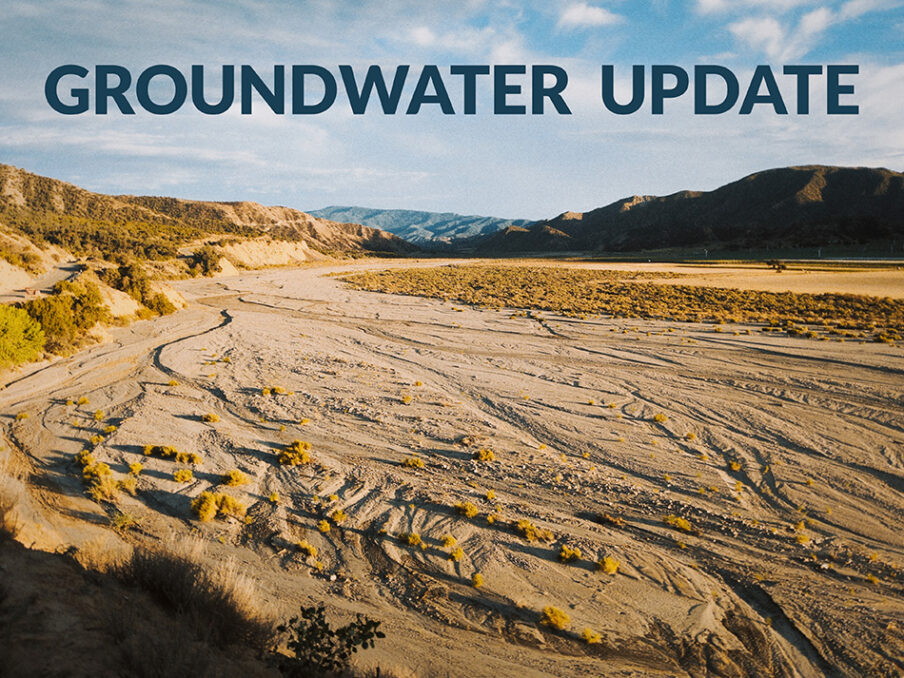
What's the brutal truth about groundwater in the Cuyama Valley? And no, that's not a trick question. The answer is pretty simple: we're running out.
The Cuyama Valley is one of just a few areas in California that has no surface water to speak of. That means you have to tap into a groundwater basin if you plan on brushing your teeth or washing your dirty dishes. And when you just look at our population — there are about a thousand of us living here — you might not think that would be a problem. But in terms of space, the Valley is roughly the same size as all five boroughs of New York City. That leaves a lot of room for irrigation and tending cattle. With no rivers or lakes in sight, farmers and ranchers in the Cuyama Valley have to install a pump and suck up the water they need directly out of the aquifer underground.
It's important to say that, in addition to being the key resource for rural economies and country living, this groundwater is a precious natural phenomenon. The term "fossil water" or "paleowater" is used to describe water that flowed into underground aquifers and has stayed there undisturbed for tens of thousands of years.
According to NASA, "Water hiding in aquifers can actually be cleaner than water resting in above-ground reservoirs because the process of percolating through soil and rock can remove impurities. Water can rest underground in aquifers for thousands or even millions of years. When geologic changes seal the aquifer off from further ‘recharging,’ the water inside is sometimes called ‘fossil water.’"
It's ancient water that literally dates back to the Ice Age. Groundwater like this has been the fountain of life in arid climates across the world — like the Arabian Aquifer that stretches from Yemen to Palestine; and the Nubian Sandstone Aquifer System that spans the Sahara, providing water to Egypt, Sudan and Libya. The relatively tiny aquifer up here in the high desert is no different. For thousands of years up to the present day, the same groundwater has sustained living civilizations like the Chumash who gave the Cuyama Valley its name.
Now you get why this is important. But who's using up all the water? That's another easy one.
Grimmway and Bolthouse, the largest carrot-growing corporations in the world, use up more groundwater than anyone else in the Cuyama Valley. And it's not even close. On average, 81% of the water that's extracted every year goes to farms owned or leased by those two corporations.
After studying the aquifer for years, hydrologists have made it plain: we need to cut our water use by half. If we continue to pump at the current rate — an annual average of 40,000 acre feet across the entire Valley — there will be no more fossil water.
In 2024, Grimmway and Bolthouse extracted more than 22,000 acre feet.
Go ahead and check the math on that one. It wouldn't make a difference if everybody else in the Cuyama Valley shut off our pumps for good tomorrow. Those two companies alone would still be using more than what Cuyama's groundwater basin can sustain.
Let's sum it all up. Underneath the Cuyama Valley there is a precious, non-renewable resource. Local farmers, ranchers and families depend on it for survival. Unless we make major reductions in our rate of extraction, our fossil water will go the way of the dinosaurs. We know precisely how much is too much. And we know who the two companies are that use way more than anyone else combined.
With all this in mind, how do we get our water pumping down to a sustainable level? This question should be the easiest, right?
But this is exactly where it starts to get complicated.
Undermining local governance
In 2014, the California legislature passed a series of bills that are collectively known as the Sustainable Groundwater Management Act (SGMA). It was actually the first time the State of California legally addressed industrial water consumption in one hundred years, since the Water Commission Act in 1914, which created a regulatory body for issue permits to use surface water. Before SGMA, groundwater usage had been completely unregulated in California.
What's important is that SGMA emphasized "local governance," the idea being that people living in areas with critically overdrafted groundwater basins should be the ones deciding how to reach sustainability. It called for each jurisdiction to create a Groundwater Sustainability Agency (GSA) with the mission of figuring out how to reduce water pumping — a Groundwater Sustainability Plan (GSP).
Cuyama's GSP was submitted to the Department of Water Resources for review last year. You can check it out here on the Cuyama Valley GSA's website. If you click on "Executive Summary," you can get an idea of how the plan was put together and all the work that went into it.
The strategy from the big landowners seems to have evolved this way: first, throw as much money at drafting a GSP that protects their assets.
When us locals wanted to actually take part in the 'local governance,' the big landowners figured they'd get a better deal in the courts. They sued everybody in the Valley who claimed water rights on their property and took us to court. Unfortunately for them, the judge who took their case — Los Angeles Superior Court Judge William Highberger — seems to reject their warped idea of what's fair and equitable. This lawsuit is the basis for this notorious "adjudication" Quail Springs has been working on for years.
The work Quail Springs has been doing — alongside community allies like the Small Farmers and Ranchers Network and the Cuyama Valley Family Resource Center — has finally born some fruit. This month, Highberger issued a ruling that says over a hundred small landowners are not subject to the big landowners' lawfare attacks on their water rights.
“I think that giving the people who currently are minor extractors some hope that their dream homes and dream ranches can continue to be enjoyed by themselves and future generations and that they can try to improve the economic utility of their assets will be an important stabilizing factor in this remote community," the judge wrote in his tentative order. He acknowledged that small landowners have been scrupulous in their conservation efforts to not overextract what they need for their businesses — strongly implying that the carrot-growers have been doing anything but.
If this ruling holds, some of the smallest landowners in the Valley — meaning farmers and ranchers who use less than 5 acre feet of water a year — will technically be able to increase their water intake. Highberger considers this "a reward for those who feel a historic connection to the land and the community to stay there and enjoy the many charms of the Cuyama Valley.”
It's cause for celebration.
What happens next?
So, now that the litigation strategy may have backfired on them, Grimmway and Bolthouse have taken over the GSA completely. Their corporate coup d'etat resulted in two local landowners getting kicked off the board. They've been replaced by two empty suits who will vote the way they're paid to.
They were able to pull this off by changing the rules around who in the Cuyama Valley gets to vote. It used to be, essentially, a "one acre, one vote" system, which already favored the big landowners by saying the people who have the most land get the most say. But in a slick move to enhance their interests even further, the rules changed to only count irrigated acreage — this reduced the franchise of large ranchland owners and others who claim water rights that they don't exercise at the current moment.
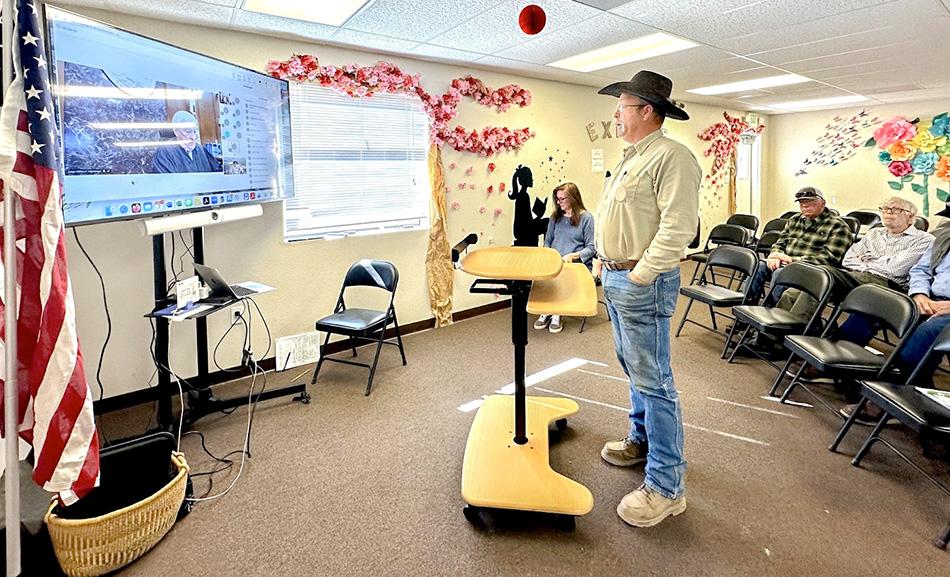
Steve Lundberg speaks to Judge William Highberger at a virtual hearing on November 7. (Photo credit: Louis Henry, SJV Water)
SJV Water is a nonprofit, independent online news publication covering water in the San Joaquin Valley. Lois Henry is the CEO/Editor of SJV Water and can be reached at www.sjvwater.org.
In their briefs the plaintiffs' lawyers actually refer to groundwater usage as a "zero sum game," which says a lot about where they're coming from. 'The more you have, the less we have.'
Now Grimmway and Bolthouse did to the GSA something akin to what they tried way back at the beginning of the lawsuit. Years ago, they changed the corporate entity who represents their interests: first the farming companies themselves, then the real estate companies owned by Bolthouse and Grimmway. But regardless of whether it's a "farm management LLC" that appears on court briefs, it's still all the same players and all the same money.
They say it's not relevant who drained the basin. Everyone needs to pump less "regardless of the amount." Wring out a dishrag in the Cuyama Valley and Grimmway and Bolthouse want you to count the drops — and then cut back the same percentage of water as them.
Quail Springs continues to provide support to our fellow defendants in this case and we hope you'll keep following our progress. We'll be hosting events on groundwater throughout the springtime — including a screening of a new documentary about the Cuyama Valley in March. Follow our newsletter to find out first about when it will take place.
It's a turbulent time for the Cuyama Valley. This season brought us a generous amount of rain but also a significant amount of anxiety about the future of our groundwater.